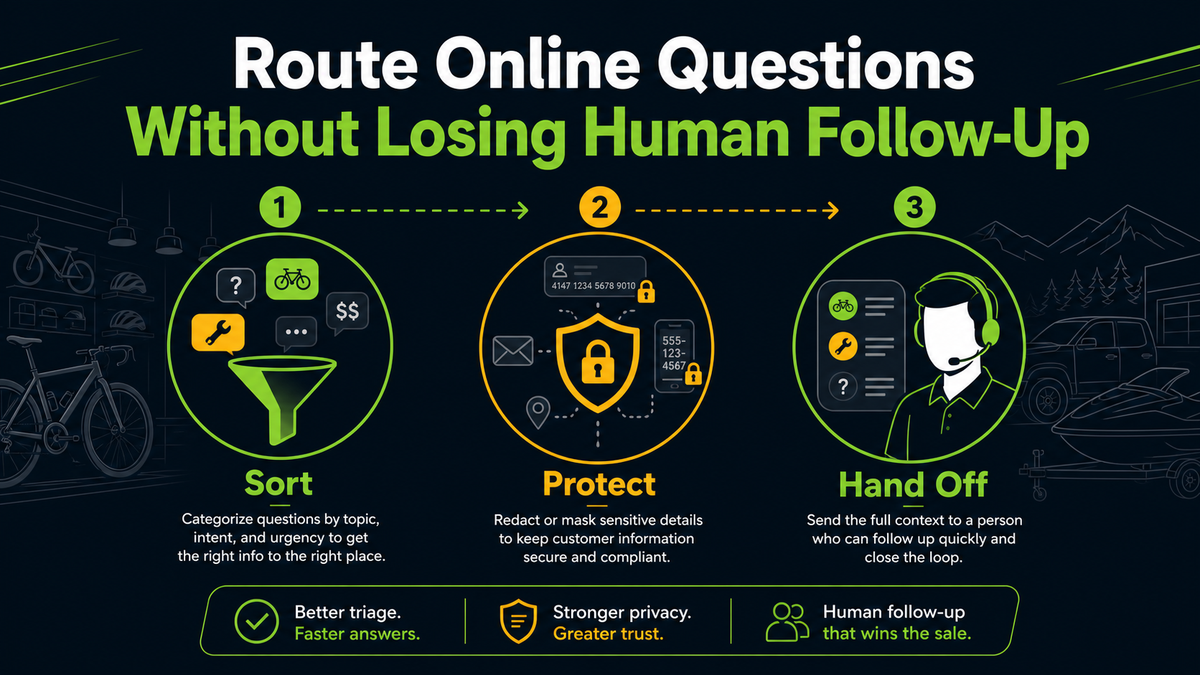
Bicycle and local vehicle retailers face a growing challenge: an overwhelming volume of online inquiries arriving across multiple channels. From questions about a specific frame size to broader inquiries concerning warranty coverage, potential buyers expect fast, accurate responses. However, when shop owners try to handle every digital message manually, they risk slowing down the buying process and frustrating the consumer. The goal for any modern local vehicle retailer should not be to automate the entire relationship, but to route online questions efficiently while preserving the critical human follow-up that builds trust and drives long-term customer loyalty.
Implementing a system to categorize and direct these digital conversations requires careful planning. Retailers must balance the speed of an automated routing framework with the nuanced expertise of their human sales and service teams. This involves evaluating the types of questions received and establishing clear boundaries for data collection, accessibility, and communication expectations.
The Omnichannel Imperative and Evolving Buyer Expectations
The retail landscape for bicycles and local vehicles is rapidly evolving into a blended, omnichannel experience. Consumers no longer draw a strict line between their online research phase and their in-store purchasing experience. Instead, they expect a seamless transition from browsing inventory on a website to asking technical questions via chat, and finally visiting the physical storefront for a test ride or final fitting.
According to the Cox Automotive 2026 Car Buyer Journey study, consumer satisfaction reaches record highs when buyers experience efficient processes driven by digital tools and AI. Buyers who complete a majority of their purchase steps online save significant time and report a higher level of satisfaction. While this data highlights the automotive sector, the underlying consumer psychology applies equally to bicycle retailers. A flexible omnichannel approach—where an online routing system smoothly transitions a shopper to a knowledgeable staff member—is now the baseline expectation.
When a customer asks a complex question about an electric vehicle’s battery range, a generic automated response is insufficient. Instead, the initial digital interaction must quickly identify the nature of the inquiry and route it to the appropriate human expert within the store. This connected experience is what operationalizes technology effectively. For shop owners looking to refine their approach, integrating a thorough automotive chatbot evaluation checklist can provide a deeper vehicle-retail framework to assess how inquiries are handled and directed.
Categorizing and Routing Inquiries for Faster Handoffs
To prevent a bottleneck of unanswered messages, retailers must develop a classification system for incoming questions. Not all inquiries carry the same urgency. By separating messages into distinct categories, shops can ensure the right staff member addresses the right problem at the right time.
Key categories should include sales, service, parts, fit, warranty, safety, finance, and urgent operational questions. When setting up an online routing structure, it is critical to avoid making any binding promises or providing definitive diagnoses before a human expert has assessed the situation. For example, if a customer describes a strange noise coming from their drivetrain, the system should route the question to the service department rather than attempting to diagnose the mechanical issue automatically.
The following table outlines a basic framework for separating these common inquiries and defining the expected handoff protocol.
| Inquiry Category | Examples | Routing Destination | Handoff Protocol |
|---|---|---|---|
| Sales & Inventory | “Do you have this e-bike in a medium?” | Sales Team | Acknowledge interest, confirm staff will check the floor, and follow up. |
| Service & Maintenance | “How often should I tune my suspension?” | Service Department | Do not diagnose. Request the customer bring the vehicle in for a visual inspection. |
| Parts & Accessories | “Can I order a replacement derailleur hanger?” | Parts/Merchandising | Verify part number or compatibility and provide availability timeline. |
| Fit & Sizing | “I am 5’10, what size frame do I need?” | Fit Specialist | Provide general sizing charts but emphasize the necessity of an in-store fit session. |
| Warranty & Safety | “Are there recalls on this battery?” | Warranty Rep | Avoid guarantees. Collect serial number and state that physical review is required. |
| Finance & Purchasing | “What is the layaway policy?” | Finance Desk | Provide general policy information and direct to human staff for specific terms. |
| Urgent/Operational | “Are you open today?” | General Reception | Provide immediate, predefined factual answers regarding store operations. |
Defining Information Collection and Protecting Privacy
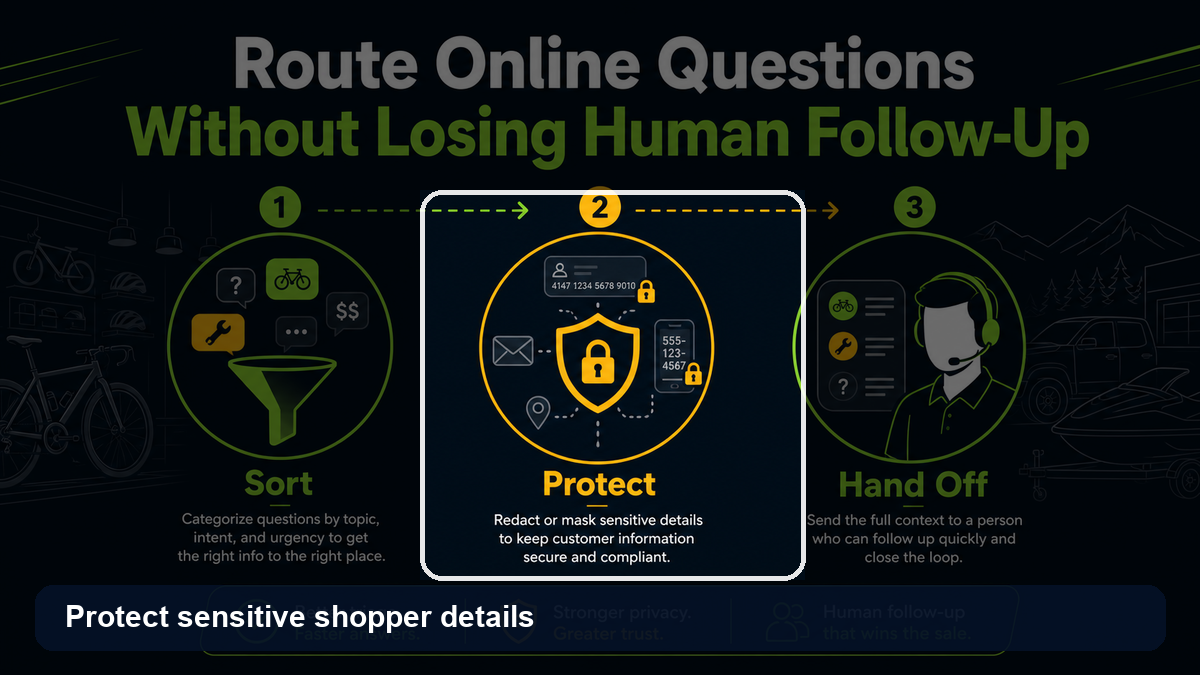
As digital inquiries increase, so does the responsibility of handling consumer data. Local retailers must prioritize collecting only the minimum information necessary to route a question effectively. Asking for excessive personal details upfront can deter potential buyers and complicate data management.
When a user initiates an online form, the system should request only the essentials: a name, a contact method, and the specific question. Once the human follow-up occurs, staff can request further details if the transaction progresses. This minimalist approach aligns with the principles outlined in the FTC Privacy Rule auto-dealer FAQ. While the FTC’s guidance is tailored to larger dealerships, the underlying best practice is universal: collect and retain data only for as long as there is a legitimate business need. By limiting initial data collection, bicycle and local vehicle retailers reduce their risk profile and streamline the customer’s path to a human conversation.
Establishing Accessibility Standards and After-Hours Protocols
A truly effective inquiry routing system must be accessible to all potential buyers. Retailers should ensure their digital touchpoints comply with recognized accessibility standards, such as those detailed in the W3C WCAG overview. The Web Content Accessibility Guidelines emphasize four core principles: content must be perceivable, operable, understandable, and robust. This means that online chat interfaces, contact forms, and routing menus should be navigable via keyboard, readable by screen readers, and designed with clear language. Ignoring accessibility alienates a segment of the customer base and undermines the goal of providing a seamless omnichannel experience.
Equally important is managing expectations outside of normal business hours. When a potential buyer sends a message late at night, the routing system must clearly communicate the shop’s operational status. A simple, automated reply stating, “Our team is currently away, but your message has been routed to our service department, and a technician will contact you when we open at 9:00 AM tomorrow,” sets a clear, realistic expectation. This transparency prevents frustration and assures the customer that their inquiry is in the queue for human review.
Structuring Human Follow-Up and Visible Handoffs
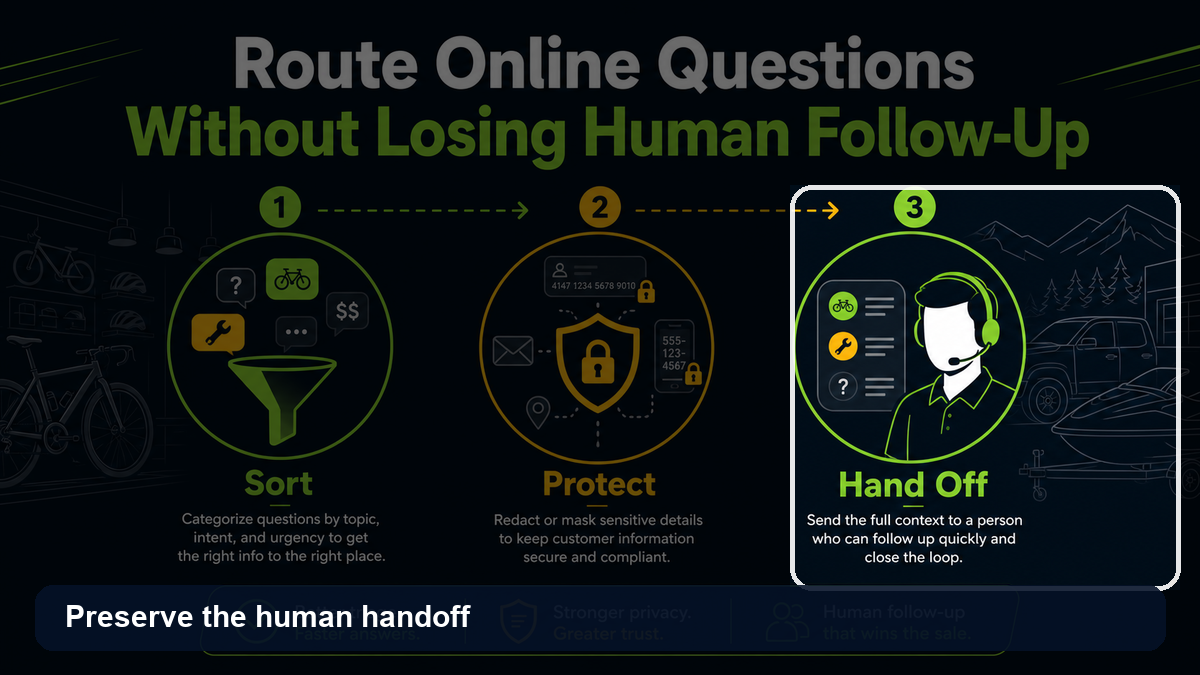
The most critical moment in the online inquiry process is the handoff from the routing system to the human staff member. This transition must be visible and clearly articulated to the customer. If a user asks a technical question and receives a response from “The Service Team,” it lacks the personal connection that local shops rely on. Instead, the follow-up should specify ownership: “Hi, this is Mark from the service department. I’ve reviewed your question about the suspension tuning.”
Making handoff ownership visible builds immediate rapport. Furthermore, understanding the broader market context can help staff tailor their responses. For instance, staff should be aware of how buyers should review a local bike shop before making an offer to ensure their follow-up addresses common consumer concerns. Similarly, recognizing how bicycle shop buyers should read local market signals before an offer allows management to adjust their routing strategies based on seasonal demand.
Executing a Small-Store Pilot Strategy
Implementing a new routing system across all departments simultaneously can be disruptive. For small to medium-sized bicycle and vehicle retailers, a phased approach is often more successful. A small-store pilot allows management to test the routing logic, evaluate staff response times, and refine the information collection process before a full rollout.
- Identify the highest-volume inquiry category: Begin by analyzing past messages to determine which department receives the most questions.
- Define the routing logic for the pilot category: Establish the specific keywords that will direct messages to this department.
- Draft standardized handoff templates: Create flexible, human-sounding templates for staff to use when initiating follow-up conversations.
- Set data collection boundaries: Configure the system to ask only for a name, contact method, and the core question.
- Establish an after-hours response: Program a clear message that states the shop’s operating hours and expected response timeline.
- Train the designated pilot team: Ensure the staff members understand the goal is swift human follow-up, not automated diagnosis.
- Monitor and adjust: After two weeks, review the conversation logs to identify bottlenecks and adjust the system parameters accordingly.
By focusing on efficient routing, protecting user privacy, ensuring accessibility, and maintaining visible human ownership, local retailers can manage digital inquiries effectively. The objective remains clear: use technology to organize the conversation, but rely on human expertise to close the sale.
Frequently Asked Questions
How should a local retailer handle complex diagnostic questions online?
Retailers should explicitly avoid providing binding diagnoses or attempting to troubleshoot complex mechanical issues through online messaging. The system should route these inquiries to the service department, where a human technician will request a comprehensive physical evaluation.
Why is it important to collect the minimum information necessary during an initial inquiry?
Collecting only the essential information reduces friction for the user and minimizes the shop’s data management responsibilities. This aligns with broader privacy best practices, ensuring that sensitive details are only discussed once a secure, human-led interaction is established.
What role does accessibility play in an online routing system?
Accessibility is vital for reaching all potential customers. Following standards like the W3C Web Content Accessibility Guidelines (WCAG) ensures that digital forms and chat interfaces are usable by individuals utilizing assistive technologies, promoting an inclusive omnichannel experience.
How can a small shop implement inquiry routing without overwhelming staff?
A phased implementation, or a small-store pilot, is the best approach. By initially applying the routing system to a single, high-volume category, the staff can adapt to the new workflow and refine their handoff protocols before expanding the system to all departments.
What is the best way to manage customer expectations after business hours?
The system should automatically communicate the shop’s current closed status and provide a clear timeline for when the customer can expect a human response. Transparency regarding operating hours prevents frustration and reassures the buyer that their inquiry has been successfully received.