
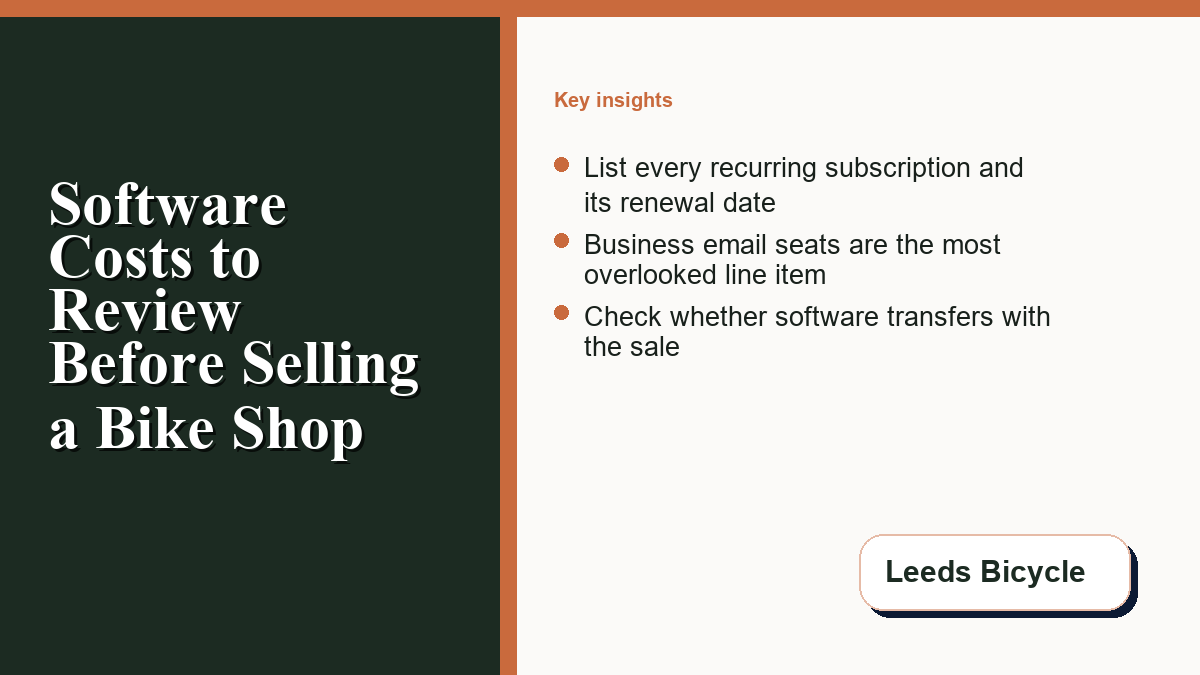
A buyer reviewing a bike shop’s books rarely stops at revenue and margin. Recurring software and subscription charges show up on the profit and loss statement every month, and a buyer will ask what each one does, whether it transfers, and whether the price is about to change. Shops that answer those questions with a clean list close faster than shops that answer them from memory.
This is a companion piece to our broader guide on when a bicycle shop owner should bring in a broker. Before that conversation happens, it helps to already know what your recurring software stack actually costs.
Start With a Line-By-Line List
Most shops run five to ten recurring services once you count everything: point-of-sale, inventory and repair-ticket software, accounting, email marketing, a scheduling or appointment tool for service bookings, and a business email and productivity suite. Pull twelve months of statements and list each charge, its billing cycle, and its renewal date. A buyer values predictability, and a list beats a guess every time.
Business Email and Productivity Costs Are Easy to Overlook
Shops that grew from a single owner-operator often started with a personal email address and added a proper business suite later, sometimes without ever revisiting the plan tier. Google Workspace is common in this category: Business Starter runs about $7 per user per month and Business Standard about $14, and a shop with two or three staff accounts can be paying more than necessary if nobody has checked the tier against current headcount in a year or two.
Before that line item goes into a valuation packet, it is worth checking whether a promo code google workspace accounts offer is available for new or upgraded accounts. A first-year discount will not change a shop’s valuation, but it does change the monthly number a buyer sees on the statement, and a clean, current figure is easier to defend in diligence than a stale one.
What a Buyer Actually Asks
- Does the software transfer with the sale, or is it tied to the owner’s personal account? Point-of-sale and inventory systems are usually shop-owned; a productivity suite tied to a personal Gmail address is not.
- Is there a contract term, or is it month-to-month? Annual commitments show up as a liability in diligence if the buyer plans to change vendors.
- What happens to service history and customer records if a subscription lapses during the transition? A repair-ticket system with three years of service history is worth more intact than reconstructed from memory.
Put It in the Packet
A one-page software and subscription summary, dated and matched to the most recent statements, is a small addition to a diligence packet that saves real back-and-forth later. It also signals that the books are current, which is exactly the impression an owner wants to leave with a buyer.